If you're getting ready to list a home near Lake Stevens' shoreline, the number you're probably watching is the sale price. The number that's more likely to slow down your closing is a date: November 1, 2026.
That's when Snohomish County's new septic inspection requirement takes effect, and it lands at almost the same moment a separate, unrelated set of shoreline permit rules can turn a simple dock repair into a multi-agency review. Neither rule cares what your home is worth. Both can hold up a closing that has nothing else standing in its way.
A county health rule with a hard date
On April 14, 2026, the Snohomish County Board of Health adopted Ordinance BOH26-02, which requires every septic system to be inspected before the property it serves can be sold. The ordinance takes effect November 1, 2026, which puts it roughly three months out from today. It brings the county in line with a state rule, WAC 246-272A-0270, that will require the same thing in every Washington county starting February 1, 2027. Snohomish County is simply moving first.
The scale of what this touches is worth sitting with. The county has about 84,000 private septic systems, and roughly 2,800 of them change ownership in a typical year, according to figures the Health Department shared alongside the ordinance. Lake Stevens carries more than its share of that inventory. Sewer service reached much of the city over the past few decades, but a meaningful number of homes ringing the lake, especially older ones on smaller shoreline lots, were built and permitted before that infrastructure existed and still run on septic today.
The requirement itself is manageable if you plan for it. A certified septic professional has to inspect the system, and the tank must be pumped if the inspection calls for it. According to the county's Property Transfer FAQ, that inspection can be completed up to one year before closing, which means a seller who orders it early doesn't have to scramble once an offer is in hand. Board of Health Chair Megan Dunn framed the intent plainly when the ordinance passed, saying the goal is to give homebuyers clear information about the condition of a property. Environmental Health Division director Ragina Gray put the practical version of that even more directly: if you plan ahead, this requirement won't slow down a home sale.
Here's the part that changes the calculus for anyone already under contract or close to it. If an inspection turns up a deficiency, such as surfacing sewage or another immediate health hazard, and the seller doesn't resolve it before closing, the county doesn't simply let it ride. Per the same Property Transfer FAQ, the Health Department resets enforcement with the buyer, who becomes responsible for fixing the problem as the new owner. That's a liability transfer most buyers don't expect to inherit along with the keys, and it's exactly the kind of detail that belongs in a pre-offer conversation, not a post-closing surprise.
A shoreline rule that never offered a grace period
The second clock has been running for years, but it collides with the septic timeline in a way most sellers don't anticipate.
Lake Stevens' Shoreline Master Program governs any property within 200 feet of the lake's ordinary high-water mark, along with a few other water bodies in the city, according to the city's Shoreline Master Program page. That 200-foot band covers most of what buyers picture when they search for lakefront property here, and it means dock work, bulkhead repairs, and even some landscaping near the water can require review well beyond a standard building permit.
The dollar thresholds that separate a quick exemption from a full shoreline application are written directly into county code. Under SCC 30.44.120, a dock built to replace an existing one, at equal or smaller size, is exempt from a Shoreline Substantial Development Permit if its fair market value doesn't exceed $22,500. A new dock, or one that isn't a like-for-like replacement, has to stay under $11,200 to qualify for the same exemption. Cross either line and the project needs the full shoreline permit process, which can pull in the state Department of Ecology as well as the county.
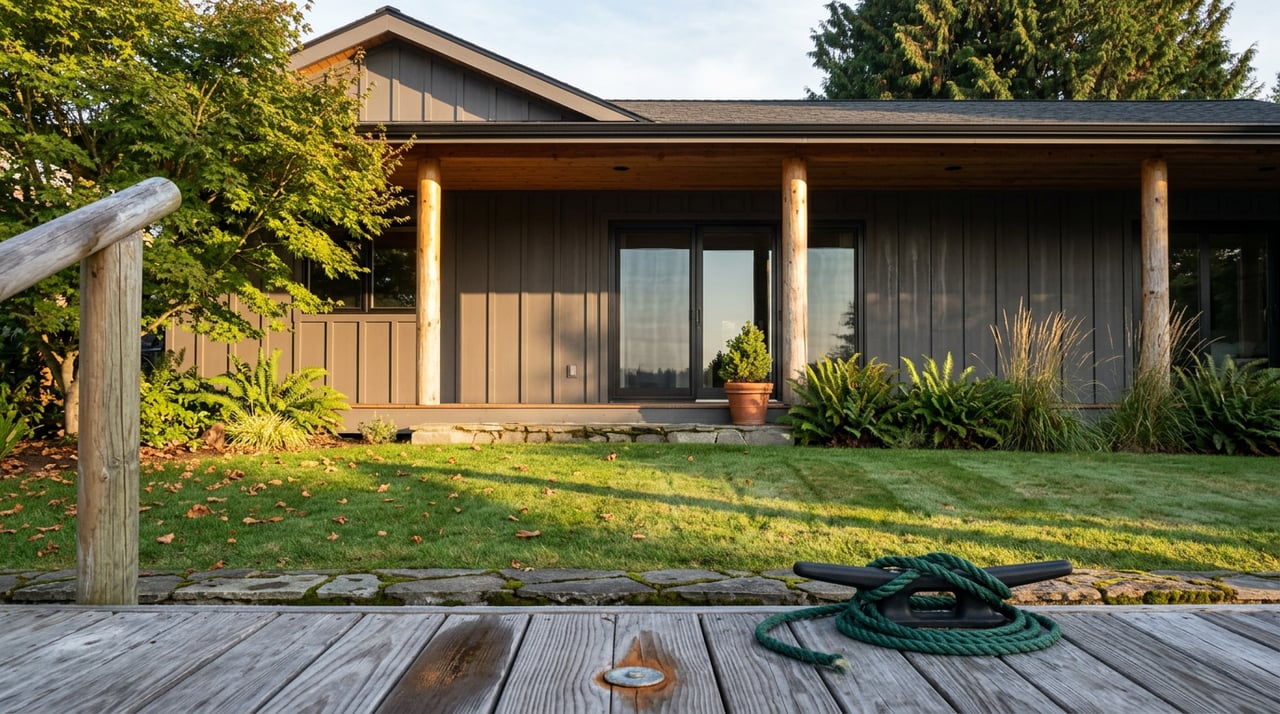
Even projects that fit comfortably under those numbers aren't automatically in the clear. County code addresses boat mooring facilities in detail under SCC 30.67.517, which caps a private swim float or floating dock at 100 square feet of surface area, requires open decking that lets light and water pass through, and limits a boathouse to a roof and support structure with no side walls at all. A boathouse also has to sit at least three feet from the side property line unless the neighbor sharing that line agrees to waive the setback. None of this is exotic regulation. It's the ordinary shape of shoreline law in Washington, and it applies whether the home behind it is a modest cabin-style property or a much larger lakefront build.
Two agencies, zero overlap, and a threshold that doesn't scale with price
Here's the part that actually matters for how you think about a fall closing on this lake.
The septic rule comes from the county Health Department. The shoreline rule comes from city planning and, in some cases, the state. They don't check each other's boxes, and clearing one tells you nothing about where you stand on the other. A seller who orders a septic inspection in September and feels ready for closing may still be sitting on an unresolved dock question that has nothing to do with the health department at all.
The more interesting wrinkle is that the shoreline dollar thresholds are fixed numbers, not percentages. An $11,200 cap on a new dock is the same whether the home behind it is priced at $600,000 or $1.8 million. For a buyer stretching to afford a smaller near-shore property, that threshold can absorb most or all of a modest dock repair budget, pushing a project that felt like routine maintenance into full permit territory. For a buyer at the top of the lakefront market, the same dollar figure is a rounding error next to the purchase price, and the permit process becomes a planning inconvenience rather than a budget problem. The rule is identical. What it costs you, relative to everything else about the purchase, depends entirely on where you sit on the price spectrum, which is not something the median sale price for Lake Stevens tells you at all.
What this means before you list or write an offer
If you're selling a septic-served home near the water this fall, the practical move is to get the inspection scheduled now rather than waiting for an accepted offer. Since inspections are valid for up to a year before closing, ordering one in August or September gives you a clean report in hand well before the November 1 deadline changes how quickly a certified professional can get to your property.
If you're buying, and any part of your plan involves touching the dock, bulkhead, or shoreline landscaping, it's worth asking two questions before you write the offer:
- What did the existing dock or structure cost to build, and does a repair or replacement stay under the county's fair market value exemption, or does it cross into full shoreline permit territory
- Is the structure already legally nonconforming, since expanding a nonconforming waterfront structure is generally not allowed even if the rest of the project would otherwise qualify for an exemption
Getting answers to both before closing, rather than after, is the difference between a dock project that starts the following spring and one that spends its first year in a permit queue.
A few questions sellers ask
Does the septic rule apply if my home is already on city sewer? No. The November 1, 2026 requirement applies specifically to properties served by an on-site septic system. Homes connected to municipal sewer aren't affected by this ordinance.
I had my tank pumped earlier this year. Does that count? Pumping alone isn't the same as the inspection the ordinance requires, though pumping is often part of a full inspection. Ask the septic professional you use whether their visit satisfies the Report of Property Transfer requirement, since routine maintenance and a point-of-sale inspection aren't automatically the same service.
Does replacing dock decking count toward the permit threshold? It can. County code treats a dock's fair market value as the relevant figure for the exemption, and decking replacement is generally counted as part of that value even when it doesn't require a separate building permit, so it's worth pricing the full project before assuming it stays under the cap.
What happens if the county finds a septic deficiency mid-transaction? If the seller doesn't resolve it before closing, responsibility shifts to the buyer, who inherits the obligation to fix the issue as the new owner. This is worth raising directly with your agent and lender well before the inspection report comes back.
Selling or buying near Lake Stevens' shoreline this fall isn't complicated once you know where the actual friction points are, and neither of them is the price. If you want help mapping these timelines against a specific property before you list or make an offer, Julie Ochoa is happy to walk through it with you. Let's Connect.